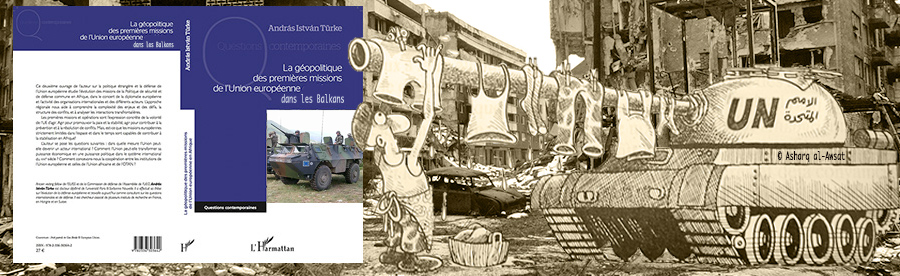
El kell dönteni, hogy mi a fontos és mi a nem fontos, és persze el kell dönteni, hogy mi mennyire fontos. Ideális esetben a védelmi szféra a szuverén nemzeti létezés - rosszabb esetben az arra irányuló remény - alapvető intézményrendszere. Állapota annak tükre. Következésképp sem szolgalelkűségnek-önfeladásnak, sem öncélnak-kisajátításnak nem a terepe ugye.
Addig is, ha nem vagy képes háborúzni, keresd a békét.
Zord
La route des Balkans reste toujours l'une des principales voies d'accès l'Union européenne, pour les exilés du Proche et du Moyen Orient, d'Afrique ou d'Asie. Alors que les frontières Schengen se ferment, Frontex se déploie dans les Balkans, qui sont toujours un « sas d'accès » à la « forteresse Europe ». Notre fil d'infos en continu.
- Le fil de l'Info / Bosnie-Herzégovine, Albanie, Kosovo, Bulgarie, Questions européennes, Populations, minorités et migrations, Migrants Balkans, Courrier des Balkans, Croatie, Turquie, Grèce, Moldavie, Macédoine du Nord, Monténégro, Slovénie, Roumanie, Serbie, Gratuit, Grèce immigrationLes perturbations du trafic aérien et la hausse des coûts de transport liées au conflit au Moyen-Orient pourraient modifier les flux touristiques en Europe. La Croatie et l'Albanie apparaissent comme des alternatives attractives, tandis que le Monténégro et la Grèce pourraient être plus exposés aux incertitudes du secteur.
- Le fil de l'Info / Une - Diaporama, Radio Slobodna Evropa, Tourisme balkans, Guerre Moyen Orient, Albanie, Croatie, Grèce, Monténégro, Economie, Une - Diaporama - En premierLes perturbations du trafic aérien et la hausse des coûts de transport liées au conflit au Moyen-Orient pourraient modifier les flux touristiques en Europe. La Croatie et l'Albanie apparaissent comme des alternatives attractives, tandis que le Monténégro et la Grèce pourraient être plus exposés aux incertitudes du secteur.
- Le fil de l'Info / Une - Diaporama, Radio Slobodna Evropa, Tourisme balkans, Guerre Moyen Orient, Albanie, Croatie, Grèce, Monténégro, Economie, Une - Diaporama - En premierFin mai 2025, des attentats racistes visaient des mémoriaux juifs, des synagogues et des mosquées à Berlin et Paris. Momčilo Gajić, un ressortissant serbe soupçonné d'avoir coordonné ces actes de vandalisme, se trouverait aujourd'hui en Russie.
- Le fil de l'Info / Courrier des Balkans, Serbie, Défense, police et justice, Une - DiaporamaUne nouvelle étape vient d’être franchie dans le renforcement du transport urbain en Algérie. Après Alger et Constantine, la wilaya d’Annaba bénéficie à son tour […]
L’article Transport urbain : 50 nouveaux bus mis en service dans cette wilaya est apparu en premier sur .
At a time when the traditional transatlantic relationship is more strained than ever—largely due to the almost compulsive stance of the current occupant of the White House and his circle—it is imperative for Europe to establish or strengthen strategic alliances in all domains, including in trade. Credit: EEAS
By Manuel Manonelles
BARCELONA, Spain, Mar 20 2026 (IPS)
“Europe can no longer be a custodian for the old-world order, for a world that has gone and will not return (…) we need a more realistic and interest-driven foreign policy.” These were some of the words pronounced one week ago by the President of the European Commission, Ursula von der Leyen, at the EU Ambassadors’ Conference in Brussels. A speech that sparked considerable controversy: an almost immediate rebuttal from the President of the Council, Antonio Costa; rumours of a motion of censure against Von der Leyen in the European Parliament; more or less public reproaches from several European leaders; and a swift and complete retraction by the President herself.
The question, however, remains: was this a miscalculation by a President known for always trying to swim with the current? Or do her words reflect a deeper alignment with the mindset of a new (dis)order defined by Trumpian chaos and the authoritarian impulses emanating from Beijing and Moscow, among others?
Multilateralism is not only a matter of principles; it is also a matter of responsibility, and indeed of efficiency and effectiveness. Or does Europe truly believe it can tackle the major challenges it faces—from climate change and migration flows to global public health and the impact of AI—on its own?
In the former case, despite its seriousness, the mistake would still be forgivable. In the latter, we would be facing a far more significant—and particularly dangerous—problem.
In Brussels, some interpret it as a clearly failed attempt by Von der Leyen to steer the Union’s position towards the theses defended at that time by the German Chancellor Merz—her compatriot and party colleague—on the need to adopt policies more aligned with Trump.
Position that Merz himself has changed in the last few years, taking into account his particularly weak position, with approval ratings plummeting to just 26% less than a year after taking office—figures as low as Trump’s.
Returning to the President of the Commission, it was indeed troubling to observe that -in a Europe already deeply divided over the major geopolitical challenges of our time (the war in Iran and across the Middle East, the war in Ukraine, the situation in Venezuela)- it was precisely the individual recognised globally as the face of the European Union who delivered a speech so starkly at odds with the Union’s founding principles.
For the European project, with all its strengths—and its shortcomings—was built precisely on the ashes of the Second World War, on the traumatic experience of the totalitarian regimes of the 1920s and 1930s, and in opposition to the Stalinist totalitarianism that developed beyond the Iron Curtain.
It was founded on the principles of humanism, on respect for and the promotion of human rights, and on the idea of shared social rights and values. It was also grounded in the need for a rules-based international order which, despite its many imperfections, remains the only real mechanism capable of steering us away from the chaos and the law of the jungle to which some of the world’s major powers seek to drag us.
Are the United Nations in crisis? Undoubtedly, and no one seriously disputes it. Is multilateralism in retreat, and is respect for international law at a low point? Another undeniable tragedy. However, does this mean that the response to such a bleak context should be—as I have suggested—to adopt the very mindset of those responsible for this deterioration? Put differently: have we lost all sense of reason?
We are living in turbulent times. Europe must indeed strive for greater strategic autonomy—but this autonomy cannot be confined solely to defence. It must also—and urgently—extend to genuine autonomy in the realm of technological goods and services, where dependence on the United States places Europe in a position bordering on vassalage.
Moreover, at a time when the traditional transatlantic relationship is more strained than ever—largely due to the almost compulsive stance of the current occupant of the White House and his circle—it is imperative for Europe to establish or strengthen strategic alliances in all domains, including in trade. This is already happening with India, and should be finalised as soon as possible with Mercosur.
However, to suggest that Europe’s future—or, in other words, the future of the Europe that truly matters—could lie in a further weakening of the international order and the system of international organisations is, I say this unequivocally, simply irresponsible.
For multilateralism is not only a matter of principles; it is also a matter of responsibility, and indeed of efficiency and effectiveness. Or does Europe truly believe it can tackle the major challenges it faces—from climate change and migration flows to global public health and the impact of AI—on its own?
Europe needs multilateralism, among other reasons, to remain being Europe. And for that reason, it must commit to it now more than ever—without naïveté, with realism, but fully aware of the interdependence between the future of the European project and the existence of a minimum level of order and cooperation among nations, including the major powers.
This requires defending and promoting—against the alternative of chaos—the very spaces and institutions that make such cooperation possible, rather than ignoring or sidelining them.
Manuel Manonelles is Associate Professor of International Relations at Blanquerna-Ramon Llull University in Spain
A Sudanese family in rural Wasat AL Gadaref, Gedaref State, near Khartoum, Sudan. Credit: UNICEF/Osman Saif
By Oritro Karim
UNITED NATIONS, Mar 20 2026 (IPS)
The past two weeks have marked a significantly violent escalation in the Sudanese Civil War, with drone strikes and artillery shelling between the Rapid Support Forces (RSF) and the Sudanese Armed Forces (SAF) causing widespread destruction, casualties, and displacement. With humanitarian responses critically underfunded and the scale of needs, including the hunger crisis, continuing to grow, experts warn that millions in Sudan could be affected by famine, violence, or prolonged displacement.
Since March 4, the Office of the United Nations High Commissioner for Human Rights (OHCHR) has recorded more than 200 civilian deaths resulting from drone strikes in the Kordofan region and White Nile State. In West Kordofan, SAF drone strikes have killed at least 152 civilians, hitting densely populated areas including hospitals and markets. The conflict has also spread to White Nile State, where strikes have targeted the state capital, Kosti, as well as electrical facilities—causing widespread power outages—and a student dormitory.
“It is deeply troubling that despite multiple reminders, warnings, and appeals, parties to the conflict in Sudan continue to use increasingly powerful drones to deploy explosive weapons with wide-area impacts in populated areas,” said Volker Türk, the United Nations High Commissioner for Human Rights. “It will soon be three full years since the senseless conflict in Sudan began, devastating millions of lives and livelihoods. Yet the violence, fueled by these new technologies of war, simply keeps spreading. It is high time it came to an end.”
South Darfur has also been heavily affected, with drone strikes on March 12 and 13 causing extensive damage across multiple neighborhoods. In West Darfur, strikes on a market in Akidong triggered a massive explosion that impacted the Adre border crossing—a critical lifeline for humanitarian aid deliveries and a key route in preventing widespread starvation. On March 16, a deadly drone strike hit the Sudan-Chad border in Chad’s Tine region, killing 17 people and injuring several others. Local eyewitnesses told reporters that the strikes hit mourners at a funeral, as well as children playing nearby.
UN Deputy Spokesperson for the Secretary-General Farhan Haq said that the attack reflects a growing pattern of violence affecting border communities, raising concerns about broader regional instability between neighboring countries. “The UN calls once again on all parties to comply with their clearly known obligations under international humanitarian law, which include protecting civilians and civilian infrastructure, and ensuring the rapid, safe, unimpeded delivery of humanitarian assistance to whoever needs it, and wherever it is needed,” Haq said.
Following the attack, Chad bolstered its security forces along the Sudan-Chad border to prepare for defensive operations. On March 19, Chadian President Mahamat Idriss Deby confirmed in a statement shared to social media that Chad’s army has been ordered to “retaliate, starting from tonight, to any attack coming from Sudan.”
“Despite various firm warnings addressed to the different belligerents in the Sudan conflict and the closure of the border, the town of Tine has again been the target of a drone attack,” said a spokesperson for the Chadian government. “This latest assault of extreme gravity has caused the death of 17 of our compatriots and left several others injured.”
As violence continues to escalate and spill across borders, its humanitarian consequences within Sudan are becoming increasingly pronounced. Figures from the International Organization for Migration (IOM) show that approximately 9 million people are currently internally displaced across Sudan, marking one of the largest displacement crises in the world. On March 17, several people were killed in the Bara locality, northeast of El Obeid City, the capital of North Kordofan, causing over 150 displacements from Sherim Mima Village in Bara to Um Dam Haj alone.
Displacement has gone down in recent days, with roughly 3.8 million civilians recorded to have begun returning home, particularly to Khartoum and eastern regions. Despite this, returnees face a host of challenges, including the loss of their livelihoods, infrastructure damage, and a lack of access to basic services. Roughly 55 percent of internally displaced civilians were children under 18 years old.
Additional reports from humanitarian agencies paint a grim picture of the conditions that civilians face. Doctors Without Borders, also known as Médecins Sans Frontières (MSF), reports that civilians are at great risk of being harmed by explosive remnants on the ground, recording 23 injuries, including four women and seven children, sustaining severe injuries.
The United Nations Children’s Fund (UNICEF) reports that rampant and concurrent outbreaks of cholera, measles, dengue, and Hepatitis E. have overwhelmed national health systems, which were already weakened by the vast influx of injured persons.
The World Food Programme (WFP) states that approximately 21.2 million people are currently food insecure across Sudan, with women and children disproportionately affected. The majority of female-headed households are critically food insecure. According to UNICEF, “catastrophic” malnutrition rates were recorded in Um Baru and Kornoi in North Darfur. Numerous regions are at risk of developing famine-like conditions and face severe shortages of food, clean water, healthcare, and other basic services.
Despite immense access challenges, the UN and its partners have been working on the frontlines to restore access to basic services, managing to install eight 2,000-liter water tanks in displacement shelters and schools. UNICEF has reached struggling communities with food assistance and vaccination programs, providing 787,000 children with nutrition screenings, 25,100 children with malnutrition treatment, and over 540,000 children with vaccines for Measles and Rubella.
However, these efforts remain severely constrained by chronic underfunding, with the 2026 Humanitarian Response Plan for Sudan being only 16 percent funded, reaching only $454 million of its $2.9 billion goal, which would assist over 20 million crisis-affected civilians across the country. An additional $1.6 billion is required to reach refugees and host communities in neighboring countries.
IPS UN Bureau
Follow @IPSNewsUNBureau